Finest of the Finest: Forgiveness in the Heart the NYPD
Here is a link to this weekend’s readings.

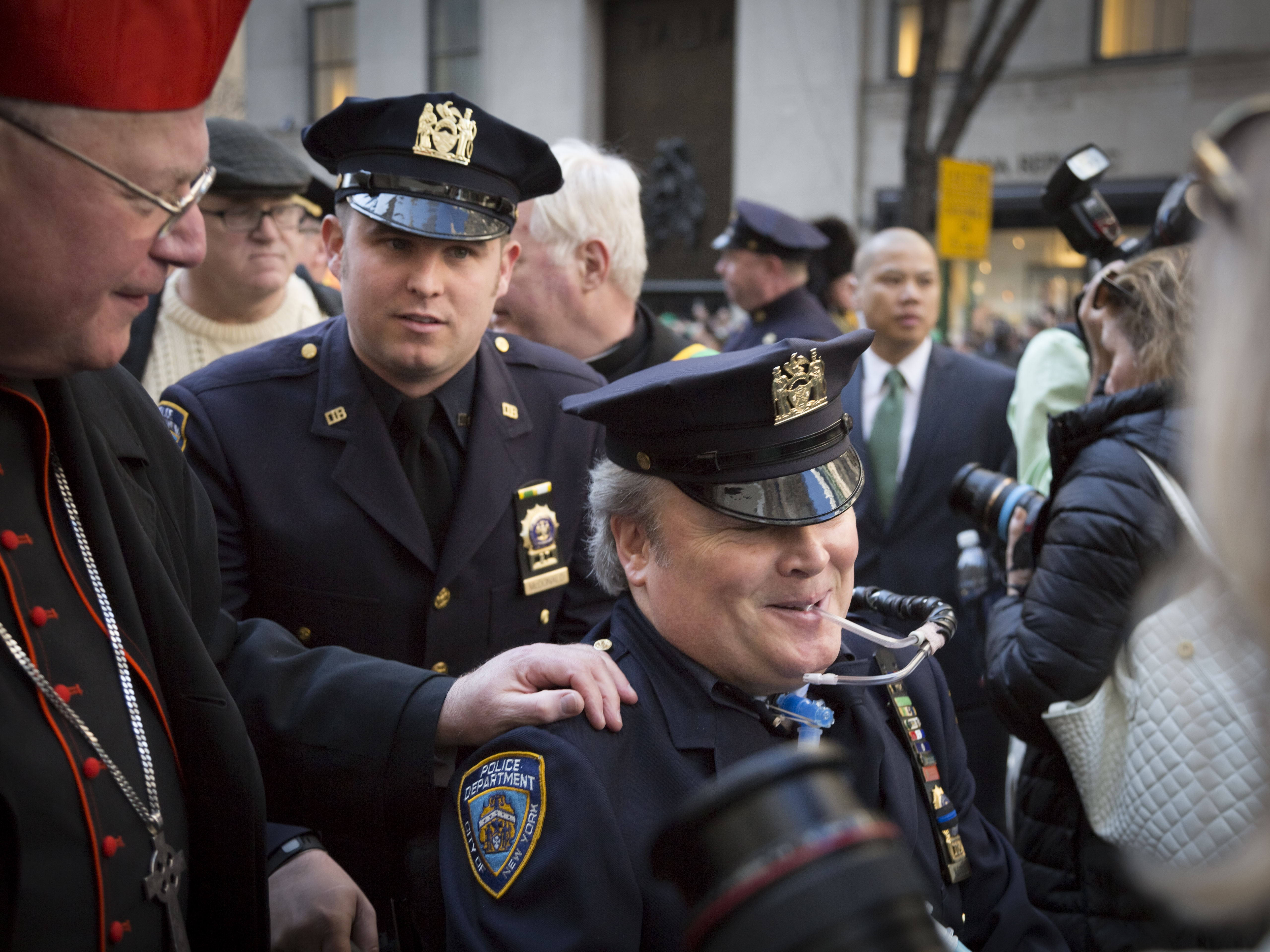
Timothy Cardinal Dolan Archbishop of New York greets NYPD Det. Steven McDonald and his son NYPD Det. Conor McDonald in front of St. Patrick’s Cathedral on Saint Patrick’s Day 2016. (Conor would be promoted to sergeant in September that year.)
One of my heroes died this past week. Many of you know him as well, and I am sure that I’m not alone in my admiration for Detective Steven McDonald of the New York City Police Department. I met him back in 1997 in Garrison, NY at a youth rally organized by the Capuchin Youth and Family Ministries, with whom I was a CapCorps volunteer. You could have heard a pin drop as McDonald slowly told his story, one breath at a time, in intervals with his ventilator. His message was clear: Christian faith requires forgiveness.
In today’s Gospel acclamation, we sing, “The Word of God became flesh and dwelt among us. To those who accepted him, he gave power to become children of God.” Detective McDonald embodied these words. Like Christ from the Cross, McDonald forgave Shavod Jones, the teenager who shot him and left him paralyzed in Central Park in 1986. His wife, Patti Ann, was pregnant with their son, Conor, who is now a sergeant on the NYPD and at age 29, the same age that his father was when he was shot. Conor delivered a moving eulogy at the funeral Friday morning, presided over by Timothy Cardinal Dolan at St. Patrick’s Cathedral, calling his father “a real Superman.”
In this blog recently, we have been discussing the ecumenical movement. McDonald became a living witness of peace and unity, using the platform that his high-profile attack and act of forgiveness afforded him to promote, among other things, peace between Protestants and Catholics in Northern Ireland. In their document on ecumenism, the bishops wrote, “The faithful should remember that they promote union among Christians better, that indeed they live it better, when they try to live holier lives according to the Gospel” (Unitatis Redintegratio, 7). McDonald, by all accounts, lived up to this challenge. The witness of his life gave credibility to his words.
 One of his heroes was a man we honor this weekend, Dr. Martin Luther King, Jr. In his book, Why Forgive?, Johann Christoph Arnold wrote about this connection: “[S]omewhere in each address, [McDonald] finds a way to refer to Martin Luther King – a man who gives him unending inspiration.” Then, quoting McDonald directly, he wrote, “When I was a very young kid, Dr. King came to my town in New York. My mother went to hear him speak, and she was very impressed by what she heard… Dr. King said that there’s some good in the worst of us, and some evil in the best of us, and that when we learn this, we’ll be more loving and forgiving. He also said, ‘Forgiveness is not an occasional act, it’s a permanent attitude.’” (Reprinted in part online at Plough).
Maryknoll magazine also featured a story on Detective McDonald back in 1999, focusing on his act of forgiveness.[i] Two insights from that article continue to resonate with me. First, the author, Margaret Gaughan, quoted Maryknoll Father Peter Le Jacq regarding the act of forgiveness: “Forgiving Shavod Jones the first time helped Steven move on… but each day, faced with his disabilities, he has to forgive again.” Then, she quoted from McDonald’s own words: “No human being can come to forgiveness without God. I can accept or reject that grace any day. Pray that I will accept it every day.” His life now ended, we know that he did. Second, I will never forget how the article concluded. Conor, the son born after the shooting, was a Catholic school student, and more importantly, a keen learner at the  feet of his father. Gaughan wrote, “[W]hen the McDonalds heard Shavod Jones had been killed in an accident shortly after his release from prison, Conor went into his third grade class and asked his teacher, ‘Can we pray for the boy who shot my dad?’”
This is how the faith is handed on. In accepting God’s grace, as McDonald did, we become “children of God” and make our own the words spoken to God’s People through Isaiah: “I will make you a light to the nations, that my salvation may reach to the ends of the earth.” It may be that we reach no one but our own sons and daughters or close friends and associates, or it may appear that we don’t even reach them; but God is at work through us. As St. Teresa of Calcutta taught us, we aren’t called to be successful only faithful. With the Psalmist, our responsibility is to present ourselves to God, no matter what situation we find ourselves in, saying humbly, “Here am I, Lord; I come to do your will.”
[i] Gaughan, Margaret, “NYPD messenger of peace,” Maryknoll, September 1999, pp. 8-10.
Editorial credit: Glynnis Jones / Shutterstock, Inc. for the photo of McDonald and his son with Cardinal Dolan.