I Know My Sheep and My Sheep Know Me
Here is a link to today’s readings.
 Surveys have shown that three of the biggest influences on discerning a vocation to the priesthood are family support/encouragement, a priest-mentor, and being asked the simple question, “Have you thought about becoming a priest?” Without priests, there is no Eucharist. It is impossible to exaggerate how important priests are in the life of the Church. Without slipping into clericalism—where we forget that Baptism unites us across hierarchical differences and we wrongly put priests on an impossible pedestal—we must still recognize that without the priesthood there is no Church. The “source and summit of the Christian life” (Lumen Gentium #11) is the Eucharist, and without priests, that source dries up. We would be “like sheep without a shepherd” (Matt. 9:36).
We should be concerned about the number of churches closing in dioceses throughout the western world. We should be concerned about vocations to the priesthood and religious life. Once, we were able to run schools on the generosity of religious sisters and brothers whose vow of poverty kept tuition levels within reach of the average Catholic family. Once we ran hospitals and other institutions based on this same generosity and religious commitment. Now, they often struggle to meet the bottom line.
I did not go to Catholic schools. As a member of a large family, on a policeman’s salary, they were largely out of reach financially. I was fortunate, though, to have been influenced by great priests and religious sisters. Father Jack Kelley, God rest his soul, was a very holy man who loved the Church and connected with the people. His love for the Eucharist was contagious and his care in preaching was admirable. He was a true shepherd to his flock. My religious education came by way of the Benedictine sisters in the Maronite Church, especially Sr.  Katherine Byrne, OSB. Her patience in teaching the basics of the faith, and in answering my unending questions, was also admirable. Mostly, though, I remember that when I was accepted to college, she simply said, “Don’t forget your prayers, morning and evening.” It was the best advice I received.
Who were the priests that influenced you? Who were the religious brothers and sisters that impacted your faith? Maybe you had a bishop that made a real mark on you personally. Maybe it was a deacon or a monk or a nun. Maybe even the pope. Take a moment to reflect on how they impacted you. What did they do that made such a difference? Have you ever told them, if they are still living? Have you called on them in the Communion of Saints if they have passed away? Have you shared with your children, grandchildren, nephews, nieces, and students what an impact a priest, a deacon, a religious brother or sister can make? What have you and I done to nurture vocations?

The fresco of Jesus as The Good Shepherd in Rosenkranz Basilica, Berlin, by Theodor Nuttgens (1922)
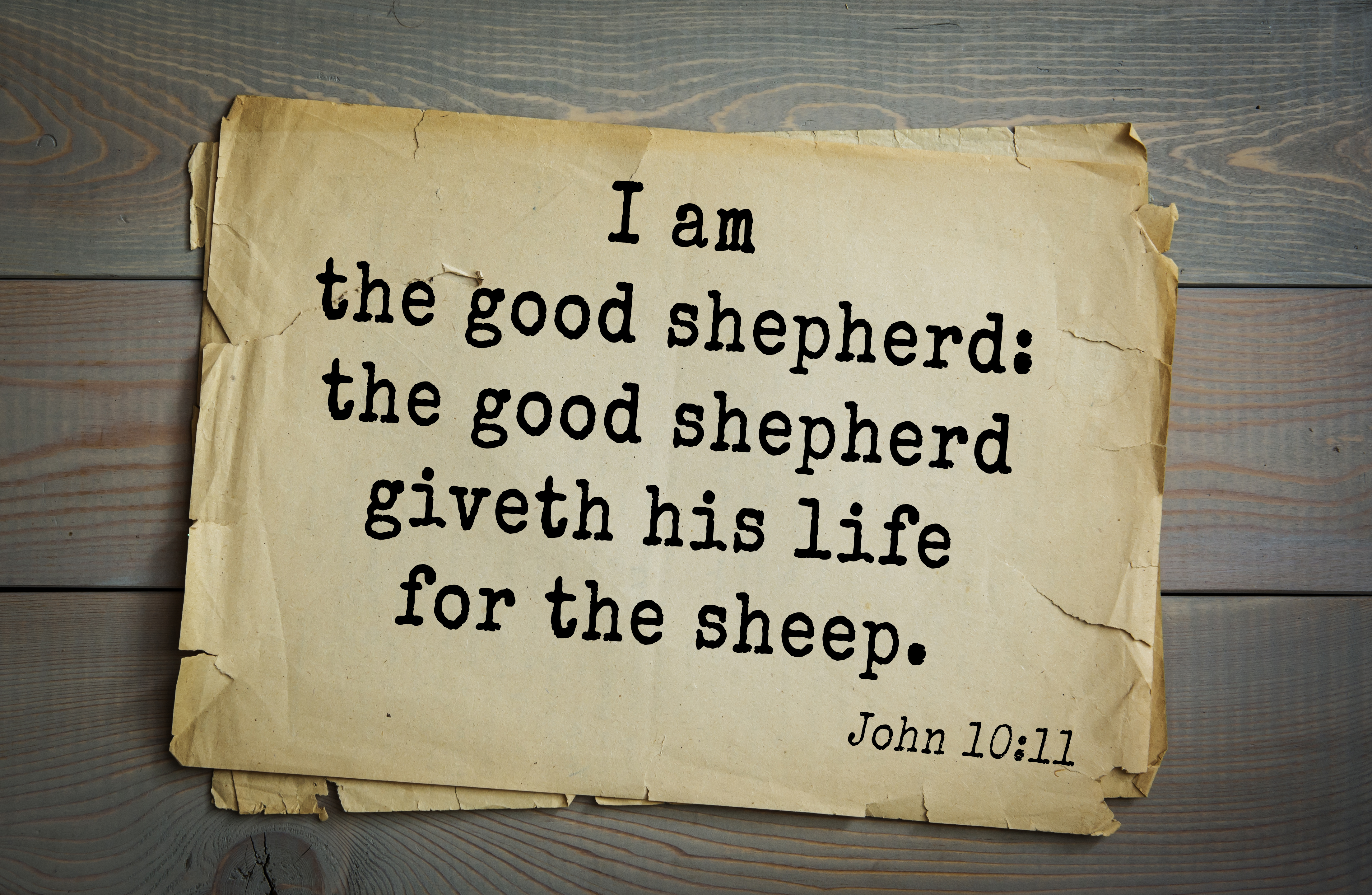
In today’s Gospel reading, we remember that Jesus is the Good Shepherd. This is not the passage about going off to find the missing sheep, however. This is the verse that tells us that Jesus Himself is the Gate through which the sheep enter. “I am the good shepherd, and I know mine and mine know me,” He says in a verse just beyond what we heard at Mass (John 10:14). Our priests are this way for us. They know us and we know them. They pastor us, and we follow their good counsel. Some will become our bishops, who are quite literally the vicars of Christ for each local church that we call a diocese. One will be called to be The Vicar of Christ for the Universal Church, the Pope. All are called to be good shepherds to the people, and to “smell like the sheep” as Pope Francis reminds us.
Do you know anyone who would make a “good shepherd?” Have you asked them if they’ve thought about the priesthood? Have you helped young people to think about religious life as a real, viable option for them? Have you spoken openly about the questions, such as whether God is calling them, whether religious life is lonely, whether giving up having a family is a loss or a gain when God calls someone to have the Church as a family, whether they are qualified—despite their human weakness and sins—to lead others, whether they love Christ present in the Eucharist and in the Church so much that they would sacrifice for Him, and whether religious life is a fulfilling, meaningful, and joyful way to spend a lifetime?

A detail of the mosaic of Jesus Christ the Good Shepherd with sheep, Rome.
Today is the World Day of Prayer for Vocations, and we are all asked to make this part of our prayer. “The harvest is abundant,” said Jesus, “but the laborers are few; so ask the master of the harvest to send out laborers into His harvest” (Luke 10:2). Aside from prayer, though, we must encourage vocations. We should make a religious vocation seem like it is—a real, living possibility. And we should accompany people on the journey, because sometimes it is lonely, and sometimes it is thankless, and sometimes it is overwhelming. “Behold,” Jesus said, “I am sending you as lambs in the midst of wolves.” (Luke 10:3). We need courageous people to serve the Church! Still, despite the hardships, there is abundant joy, especially the joy of conquering evil with good, of bringing the compassion and mercy of Jesus to the people, and of remembering what Jesus promised: “rejoice because your names are inscribed in Heaven”(Luke 10:20).
I hope you’ll tap someone on the shoulder this week. I’ll try to do the same.
Editorial credit: Renata Sedmakova / Shutterstock.com for the Berlin Good Shepherd image.
Editorial credit: Thoom / Shutterstock.com for the Roman fresco Good Shepherd image.