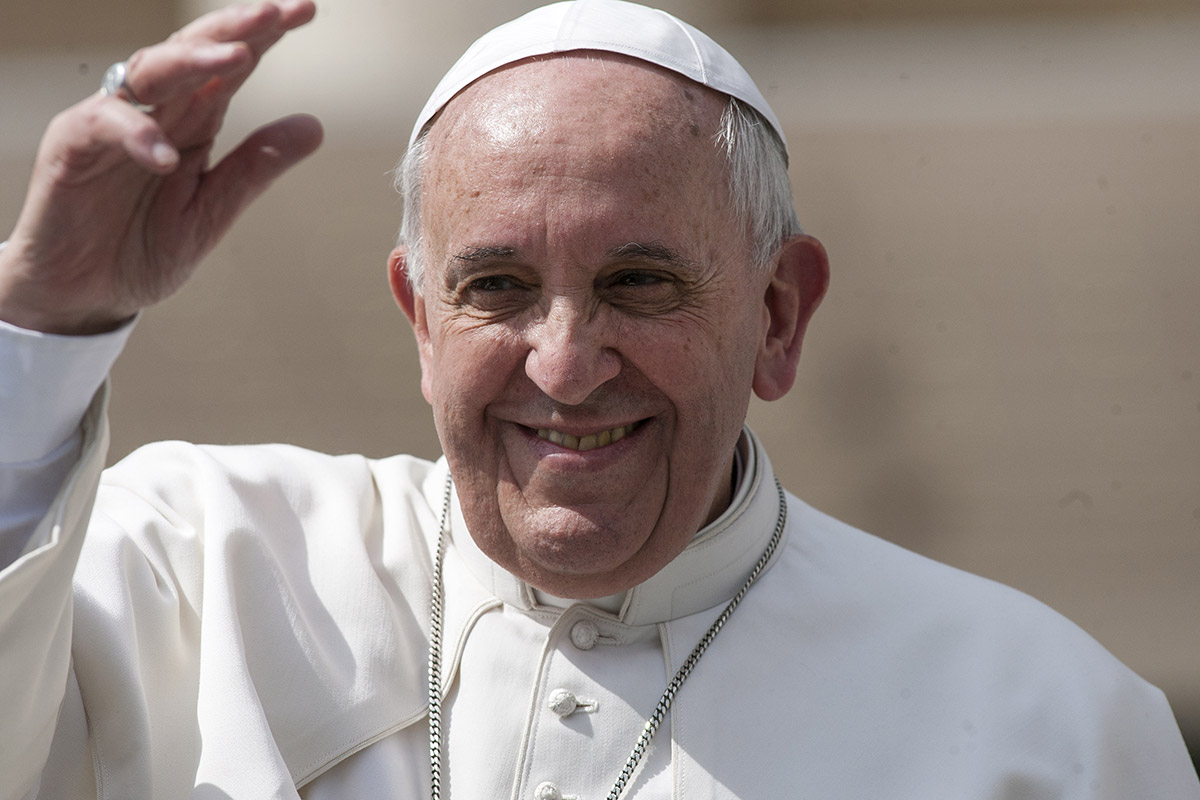
The Name of God is Mercy
Here is a link to today’s readings.
 In his book, The Name of God is Mercy, Pope Francis recalled a powerful moment from his years as a parish priest in Argentina. “I remember a mother with young children,” he wrote, “whose husband had left her… When there was no work, she had to prostitute herself to provide her children with food.” If you remember the Victor Hugo novel or the popular eponymous musical, Les Misérables, you will recall that this very situation was what moved the hero, Jean Valjean, to mercy for the poor woman, Fantine. His foil in the story is the legalistic and inflexible Inspector Javert, whose commitment to justice allows no room for mercy. The story reaches its climax with the triumph of mercy over justice, and the famous line is delivered, “to love another person is to see the face of God.”
In Argentina, Fr. Jorge Bergoglio, the future Pope Francis, gave living expression to what Hugo’s novel portrayed. His story continues: “She was humble, she came to the parish church, and we tried to help her with Caritas (our charity). I remember one day—it was during the Christmas holidays—she came with her children… and asked for me… She had come to thank me. I thought it was for the package of food from Caritas that we sent her. ‘Did you receive it?’ I asked. ‘Yes, yes, thank you for that, too. But I came here today to thank you because you never stopped calling me Señora.’” Despite knowing what she was forced to do by terrible circumstances, Fr. Bergoglio did not treat her as any less of a woman. He referred to her always by a title of dignity. He welcomed her.
So who are the very real, concrete people in our daily lives that offer us an opportunity to “see the face of God”? If you’re like me, mercy is much easier with strangers sometimes than with the people I must interact with daily. Sometimes it is someone in my own family challenging me to be merciful. Oh, and lest I get on my high horse, I readily admit that I give plenty of reasons for others to practice mercy towards me as well. Isn’t that a nice way of thinking of our faults? We are helping others to grow in mercy and they are helping us to grow as well. We are all becoming more God-like when we do.
Today’s Gospel reading is one of the most challenging in Scripture. It demands that we extend mercy even to our enemies. The Samaritan might today be renamed for us: a terrorist, a member of ISIS, a school shooter or sniper, or some other repulsive person who cannot possibly be the hero of the story. And yet, that is the hero. The enemy, the vile and repulsive one, went into the ditch and rescued the dying man. It is important to remember, Jesus told the story after being questioned by “a scholar of the law” who correctly identified the two-fold Great Commandment—love of God and love of neighbor—as the requirement for entering into eternal life. “But, because he wished to justify himself, he said to Jesus, ‘And who is my neighbor?’” At the end of the story, Jesus turned the question back to him and the man could not even say the hated name “the Samaritan,” but instead simply answered, “The one who treated  him with mercy.” It is very clear: we must see everyone, absolutely everyone, as our neighbor if we are to follow the teachings of Christ. We are not called to judge but to show mercy, even when it seems foolish and inadvisable.
If you have not had a chance to read Pope Francis’ declaration of the Year of Mercy, entitled The Face of Mercy (Misericordiae Vultus), I encourage you to take a few minutes to do so. It is a short document, just 32 pages in my edition, and it is filled with Gospel wisdom. In genuine continuity with the Gospel itself, Pope Francis tells us, “The Church feels the urgent need to proclaim God’s mercy. Her life is authentic and credible only when she becomes a convincing herald of mercy.” When we live out this challenge, we very well may see, and help others to see, that to love another person is indeed to see the face of God.
- Editorial Credit: giulio napolitano / Shutterstock.com for the image of Pope Francis